Choosing the right roof affects comfort, maintenance, resale value, and long-term safety. Composite Roof Tiles offer a practical alternative to heavier slate, fragile clay, and ordinary asphalt shingles. They can reproduce the texture of natural materials while reducing structural strain. Many products also resist moisture, impact, fading, and seasonal temperature changes.
Tom Silva, a veteran contractor and This Old House expert, has said, “A roof should protect the house first, and look good second.” That principle matters when comparing Composite Roof Tiles. A realistic slate appearance means little if the fastening system is weak. Homeowners should examine impact ratings, fire classifications, wind warranties, installation instructions, and local building requirements. A qualified roofing professional can also inspect the deck, flashing, ventilation, and underlayment before installation.
Details matter.
From years of roof maintenance experience, contractors often report fewer cracked pieces with quality composite materials. A homeowner may notice this after a hailstorm, when brittle tiles leave fragments across the driveway. Still, composite products are not maintenance-free. Poor installation, trapped moisture, or neglected gutters can shorten their service life. That is the uncomfortable part.
Price also deserves careful thought. Composite Roof Tiles may cost more initially than basic shingles. Their lighter weight, longer expected lifespan, and lower replacement frequency can improve overall value. However, product quality varies widely. Review independent testing, written warranties, installer credentials, and climate suitability before deciding. The strongest choice is not always the most attractive one. It is the roof that performs reliably above your home, year after year.
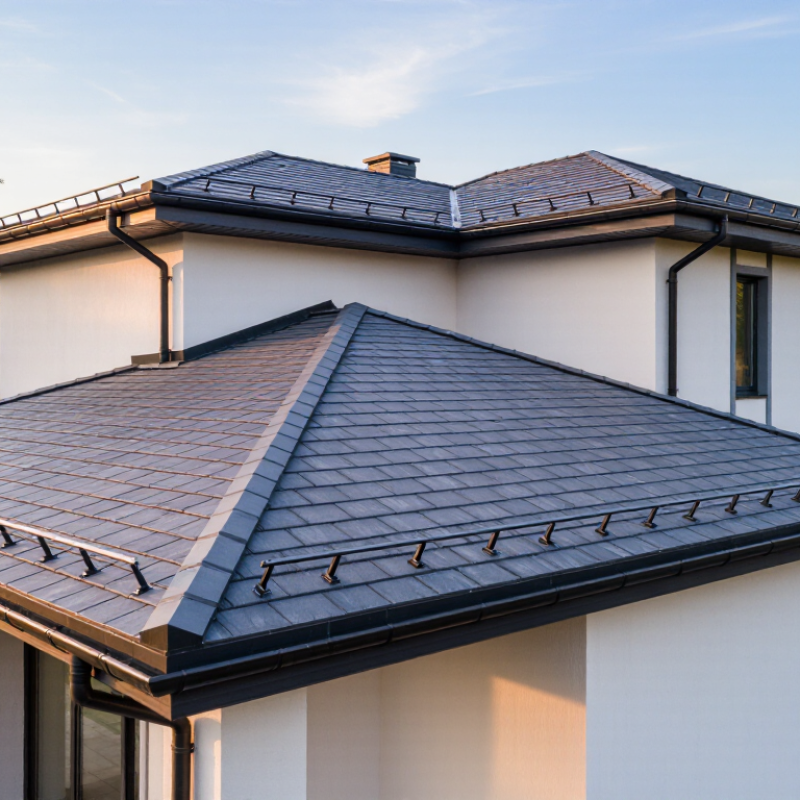
Why Choose Composite Roof Tiles for Your Home?
What Are Composite Roof Tiles?
Composite roof tiles are engineered roofing products made from polymers, resins, mineral fillers, or reinforcing fibers. Some also contain recycled materials. Manufacturers mold these ingredients into profiles that resemble slate, clay, or wood shakes. The category is not perfectly defined. Formulas differ widely, so “composite” alone does not prove quality.
A useful inspection starts with the product’s technical documents. Look for wind, fire, impact, water absorption, and freeze-thaw test results. ASTM D3161 evaluates wind resistance for steep-slope roofing, while ASTM E108 measures fire performance. Installation still matters. Poorly aligned battens or exposed fasteners can weaken an otherwise strong roof.
Composite tiles are often lighter than natural slate or concrete tile. That may reduce structural demands and simplify handling during installation. However, lighter does not always mean better. A 2020 U.S. Environmental Protection Agency report recorded about 600 million tons of construction and demolition debris in 2018. Durable materials can help reduce replacement waste, but disposal options for composite products remain inconsistent.
Energy performance also depends on color, ventilation, insulation, and local weather. The U.S. Department of Energy notes that roof reflectance and thermal emittance influence cooling demand. Dark composite tiles may absorb substantial heat under intense sun. A pale surface can perform differently. The honest answer is less dramatic: composite roofing can be practical, but only when its tested performance matches the home’s climate and structure.
Composite roof tiles begin as a carefully measured blend of polymer resin, mineral fillers, pigments, and reinforcing fibers. Some manufacturers also use recycled material, but the percentage must be verified through technical documentation. The mixture is heated, pressed, or molded under controlled pressure. This forms a dense tile with consistent thickness. Cooling matters. Uneven cooling can create warping, although this problem is often underestimated.
During design, engineers shape overlapping edges and drainage channels to move rain away from vulnerable joints. The underside may include ribs that improve stiffness without adding unnecessary weight. Profiles are tested for impact, water penetration, temperature changes, and wind uplift. Reliable data should come from published test methods, not attractive claims alone. Color is blended through the material or protected with a surface layer against ultraviolet exposure. Still, darker colors can absorb more heat.
On a real roof, installers check batten spacing, ventilation, fastener placement, and alignment before covering each section. A well-designed tile cannot correct poor installation. From an inspection perspective, straight lines and clean overlaps show careful workmanship. However, composite formulations differ, so buyers should request weight, fire classification, warranty terms, and maintenance guidance. I would question vague durability promises; service life depends on climate, roof pitch, and installation quality.
Composite roof tiles offer homeowners a practical balance between appearance, durability, and maintenance. They can resemble slate, clay, or wood without the same structural weight. That matters when an older roof structure needs careful assessment. In my experience, lighter materials simplify handling during installation. They may also reduce stress on supporting components.
Performance depends on the product, not the word composite. Look for testing under ASTM D3161 or ASTM D7158 for wind resistance. UL 790 testing can indicate fire performance, but ratings must match local requirements. The Insurance Institute for Business & Home Safety reports that wind-driven debris causes major roof damage during severe storms. Impact-rated tiles may help, although no roof is storm-proof. That distinction matters.
Energy performance needs equal honesty. The U.S. Department of Energy reports that reflective roofs can reduce peak cooling demand by 10–15% in some buildings. Composite tiles achieve this only with suitable colors, coatings, and ventilation. Check the specifications. Also, the U.S. Environmental Protection Agency reports roughly 600 million tons of construction and demolition debris in one recent assessment. Choosing tiles with verified recycled content or an environmental product declaration can support better material use. However, recycling access varies by region. A beautiful roof still creates waste if local facilities cannot process it.
| Evaluation Dimension | Composite Roof Tiles | Why It Matters to Homeowners | Typical Comparison |
|---|---|---|---|
| Expected Service Life | Approximately 30–50 years, depending on product quality, installation, climate, and maintenance | Can reduce the frequency of major roof replacement compared with shorter-life roofing materials | Generally longer-lasting than basic asphalt shingles; comparable with some premium roofing systems |
| Weight | Usually lighter than natural slate, clay, or concrete tiles; exact weight varies by design | May reduce structural demands and can simplify handling during installation | Often a practical middle ground between lightweight shingles and heavy masonry-based tiles |
| Impact Resistance | Many products are engineered to resist cracking, splitting, and damage from hail or flying debris; certification varies | Can help limit repair needs in regions exposed to severe weather | Performance is often more resilient than brittle natural slate or clay, but homeowners should verify local impact ratings |
| Moisture Resistance | Non-porous or low-porosity formulations are designed to resist water absorption and freeze-thaw damage | Helps protect the roof assembly from moisture-related deterioration when correctly installed | Typically requires less moisture-related attention than porous materials, although flashing and underlayment remain essential |
| Maintenance Requirements | Usually limited to routine inspections, gutter cleaning, removal of debris, and replacement of damaged components | Lower ongoing maintenance can save time and help identify small problems before they become expensive repairs | Often less maintenance-intensive than wood shakes, which may need more frequent treatment and inspection |
| Fire Performance | Some composite tiles achieve Class A fire ratings, but performance depends on the tested roof assembly | A higher fire rating may provide additional protection in wildfire-prone areas | Can offer stronger fire performance than untreated wood roofing; always confirm local code compliance |
| Design Flexibility | Available in profiles, textures, and colors designed to resemble slate, wood, or traditional tiles | Makes it easier to coordinate the roof with different architectural styles and exterior finishes | Provides more style options than standard asphalt shingles while avoiding some of the weight of natural materials |
| Color Retention | Quality products may include color-integrated or UV-resistant finishes; fading resistance varies by formulation | A stable appearance can preserve curb appeal and reduce the need for cosmetic replacement | Often offers more consistent long-term appearance than untreated wood, subject to sun exposure and product specifications |
| Installation Considerations | Can be installed using standard roofing practices, but slope, underlayment, fasteners, and ventilation must follow the product requirements | Correct installation is critical for wind resistance, water shedding, warranty coverage, and long-term performance | Installation is usually more straightforward than natural slate, but still requires qualified roofing professionals |
| Environmental Considerations | Some products use recycled polymers or industrial by-products and may be recyclable at end of life; this varies by manufacturer and local facilities | A longer service life can reduce replacement frequency and associated material waste | Environmental benefits depend on recycled content, production methods, transport, durability, and disposal options |
| Overall Value | Balances durability, appearance, weight, and maintenance requirements | May provide better long-term value when homeowners prioritize service life and reduced upkeep over the lowest initial price | The best choice depends on climate, roof structure, local building codes, installation costs, and expected ownership period |
Note: Performance ranges are typical industry guidelines rather than guarantees. Homeowners should review product test reports, fire and impact ratings, local building requirements, and installation instructions before selecting a roofing system.
Comparing composite tiles with traditional roofing materials requires more than comparing price tags. Asphalt shingles usually cost less initially, but replacement can arrive sooner. Clay and concrete tiles offer long service lives, yet they add substantial structural weight. Metal roofing is durable, although rain noise and denting can concern some homeowners. Composite tiles aim to balance these trade-offs. Many are designed to resemble slate or wood without the same weight and maintenance demands.
The U.S. Environmental Protection Agency reports that asphalt roofing waste contributes millions of tons to annual construction and demolition debris. That makes service life a practical environmental concern, not just a sales claim. However, performance depends on installation quality, ventilation, underlayment, and local weather. The Insurance Institute for Business & Home Safety notes that roof damage often begins at vulnerable edges, valleys, and penetrations. A strong tile cannot correct weak flashing. That comparison is not perfectly clean.
Tips: Ask for tested impact, fire, wind, and freeze-thaw ratings. Check the complete roof assembly, not only the tile. The U.S. Department of Energy explains that reflective roofing can reduce roof temperatures, especially in sunny climates. Dark composite tiles may provide less cooling benefit than lighter finishes. I would not promise lower energy bills without reviewing insulation, attic airflow, and household cooling habits. Small details matter.
Composite roof tiles can imitate slate or clay while reducing weight and simplifying handling. However, appearance should not lead the decision. Before choosing them, check your roof’s structural capacity, slope, drainage, and local weather exposure. The National Roofing Contractors Association states that roof performance depends heavily on design, installation, ventilation, and maintenance. A strong tile can still fail on a poorly detailed roof.
Fire and impact ratings deserve close attention. Look for testing under recognized standards, such as ASTM E108 for fire performance and UL 2218 for impact resistance. The Insurance Institute for Business & Home Safety’s research shows that roof covering, fastening, edges, and penetrations all influence storm damage. Do not judge protection from the tile surface alone. Underlayment matters. So does workmanship. Ask installers for documented training, project references, and written installation procedures.
Heat performance is another practical factor. The U.S. Department of Energy reports that cool roofs can lower roof temperatures and reduce cooling demand, especially in warm climates. Yet darker composite tiles may absorb more solar heat. That detail is easy to miss. Review solar reflectance, thermal emittance, and ventilation together. Also compare expected service life, repair availability, cleaning needs, and lifecycle cost. A lower purchase price may hide difficult future repairs. I would not treat a long warranty as proof of durability; warranty terms often exclude poor ventilation, severe weather, and installation errors. Composite materials can be sensible, but the right choice still depends on your specific roof.
Factors to consider include service life, maintenance expectations, appearance, installation requirements, and local weather conditions.
How to read this chart: Composite roof tiles typically offer a service life comparable to metal roofing and longer than standard asphalt shingles. Clay tiles may last longer, but they are heavier and may require additional structural support. Actual performance depends on product quality, installation, climate, maintenance, and local building requirements.